Qiskit 0.45 release notes
This page contains the release notes for Qiskit 0.45, the first release after the legacy “elements” structure was completely removed. For all release notes, including those stretching back through the old “meta-package” structure of Qiskit, see Release notes. For a table of meta-package versions, see the Qiskit 0.44 release notes.
0.45.3
Prelude
Qiskit 0.45.3 is a point release with no code changes other than to raise an ImportError if it detects it has been installed in an invalid environment with Qiskit >=1.0.
Please read our migration guide about the new packaging for help on errors, preparing for Qiskit 1.0, and more detailed background information.
Qiskit 1.0 is due to release approximately two weeks after Qiskit 0.45.3, on the 15th of February 2024, and might not yet be available when you read this message. This change is being made proactively.
The packaging structure of Qiskit is changing in Qiskit 1.0, and unfortunately the changed requirements cannot be fully communicated to pip, especially if pip install --upgrade commands are run after the environment has been initially configured. All versions of Qiskit prior to 1.0 (including this one) have an installation conflict with Qiskit 1.0 that pip will not resolve.
If import qiskit raises an ImportError for you, your environment is in an invalid state, and versions of Qiskit 0.45/0.46 and 1.0 are both reachable, which will result in subtly broken code. You will need to create a new virtual environment, and ensure that only one of the two versions are installed. In particular, if you are intending to install Qiskit 1.0, you must have no packages that depend on qiskit-terra installed; these packages are incompatible with Qiskit 1.0 and must be updated. If you are intending to install Qiskit 0.45 or 0.46, you must ensure that you have nothing attempting to install qiskit>=1.0.
If you develop a library based on Qiskit and you still have a dependency on qiskit-terra, you should urgently release a new package that depends only on qiskit. Since version 0.44, the qiskit package contained only the qiskit-terra compiler core (the component that is now simply called “Qiskit”), so if your minimum version is 0.44, you can safely switch a qiskit-terra>=0.44 dependency to qiskit>=0.44 with no change in what will be installed. For more detail and recommendations for testing and preparation, see the section for developers of the migration guide.
0.45.2
Prelude
Qiskit 0.45.2 is a small patch release, fixing several bugs found in the 0.45 release series.
Bug Fixes
-
Calling
copy()orcopy_empty_like()on aBlueprintCircuitwill now correctly propagate theglobal_phaseto the copy. Previously, the global phase would always be zero after the copy. -
QPY (using
qpy.dump()andqpy.load()) will now correctly serialize and deserialize quantum circuits with Clifford operators (Clifford). -
Fixed an issue in the
mplcircuit drawer where the text would print beyond the end of the box for aSwitchCaseOpif the default case was empty. -
The qubit-argument broadcasting of
QuantumCircuit.delay()now correctly produces individualDelayinstructions for each qubit, as intended. Previously, when given certain iterables (such assets), it would instead silently produce an invalid circuit that might fail in unusual locations. -
Fixed a bug that results in an error when a user tries to load .calibration data of a gate in
Targetin a particular situation. This occurs when the backend reports only partial calibration data, for example referencing a waveform pulse in a command definition but not including that waveform pulse in the pulse library. In this situation, the Qiskit pulse object cannot be built, resulting in a failure to build the pulse schedule for the calibration. Now when calibration data is incomplete theTargettreats it as equivalent to no calibration being reported at all and does not raise an exception. -
Fixed an issue with the
Optimize1qGatesDecompositiontranspiler pass where it would potentially resynthesize a single ideal (meaning the error rate is0.0) gate which was present in theTarget. This is now fixed so the passOptimize1qGatesDecompositionwill defer to the circuit’s gate if the error rate (which includes number of gates) are the same. Fixed #10568 -
Fixed an issue with the
OptimizeSwapBeforeMeasurepass where it would incorrectly optimize circuits involving swap and measure instructions. This commit fixes the bug by changingDAGCircuit.successors()toDAGCircuit.descendants(). Also, added a couple of extra tests to ensure that the bug is fixed. For example:from qiskit import QuantumCircuit from qiskit.transpiler.passes import OptimizeSwapBeforeMeasure pass_ = OptimizeSwapBeforeMeasure() qc = QuantumCircuit(2, 1) qc.swap(0, 1) qc.measure(0, 0) qc.measure(0, 0) print(qc.draw()) print(pass_(qc).draw())would previously print:
        ┌─┐┌─┐
q_0: ─X─┤M├┤M├
      │ └╥┘└╥┘
q_1: ─X──╫──╫─
         ║  ║
c: 1/════╩══╩═
         0  0
     ┌─┐
q_0: ┤M├───
     └╥┘┌─┐
q_1: ─╫─┤M├
      ║ └╥┘
c: 1/═╩══╩═
      0  0
and now the second ciruit is correctly optimized to:
q_0: ────── ┌─┐┌─┐ q_1: ┤M├┤M├ └╥┘└╥┘ c: 1/═╩══╩═ 0 0 -
Fix a bug in the
StabilizerStatestring representation.
0.45.1
Prelude
Qiskit Terra 0.45.1 is a small patch release, fixing several bugs found in the 0.45 release series. It is also the first release to have official support for Python 3.12. The 0.45.1 release supports Python 3.8, 3.9, 3.10, 3.11, and 3.12.
New Features
- Added support for using Qiskit with Python 3.12. As of this release Qiskit supports running with Python versions 3.8, 3.9, 3.10, 3.11, and 3.12.
Bug Fixes
-
QuantumCircuit.barrier()will now generate correct output when given asetas one of its inputs. Previously, it would append an invalid operation onto the circuit, though in practice this usually would not cause observable problems. Fixed #11208 -
The property
Instruction.condition_bitswill now correctly handle runtime classical expressions (qiskit.circuit.classical). -
Fixed the
hash()of Qiskit PulseChannelobjects (such asDriveChannel) in cases where the channel was transferred from one Python process to another that used a different hash seed. -
Conditioned custom gates imported from OpenQASM 2 will now correctly retain their conditions when pickled and deep-copied. Previously, any conditional custom gate (defined by a
gatestatement in an OpenQASM 2 file) would lose its condition when copied or pickled. -
Fixed QPY deserialization of the
StatePreparationandInitializecircuit instructions with string and integer parameters (as opposed to an explicit statevector, which was already working). Fixed #11158. -
Fixed a bug in
SabreLayoutwhere it would fail to add the register information to theLayoutobject used forTranspileLayout.initial_layout. This affected circuit visualization withQuantumCircuit.draw()andcircuit_drawer()after transpilation which would show a virtual qubit label of the formQubit[QuantumRegister(6, 'q', 0)]rather than the expected virtual qubit label using the register name (e.g.q0). Fixed #11038 -
Fixed an issue with
qpy.dump()which would cause the function to potentially ignore the value ofuse_symenginewhen serializing aScheduleBlockobject. This would result in an invalid QPY payload being generated as it would report it was using symengine for symbolic expressions but actually contain sympy serialized data. -
Fixed a bug which caused
UnitaryOverlapto error upon initialization if given an input circuit containing a barrier.
0.45.0
Prelude
Qiskit 0.45.0 is the last feature release before 1.0. It prepares the ground for the API changes we are planning for our first major version release, including many removals of previously deprecated functionality as well as a series of new deprecations.
If your project depends on Qiskit, it may rely on functionality that will no longer be supported in Qiskit 1.0. For this reason, we recommend that you proactively cap your supported version to <1.0.
Some feature highlights of Qiskit 0.45.0 are:
- Starting in this release, all unparametrized gates in the Qiskit standard circuit library are now singletons. By default, these gates share a single instance in memory, so once a gate of a specific type, let’s say
XGate, is instantiated, any subsequent instances ofXGatewill be a reference to the first one. This results in a reduced memory usage and construction overhead when using multiple gates of the same type in a circuit. To realize this feature, new base classes have been introduced:SingletonInstructionandSingletonGate. See feature notes for more details. - We have added a new generic pass manager interface that can be found in the new
qiskit.passmanagermodule. This is a generalization of the pass manager that was used to build the Qiskit transpiler, and it introduces a generic framework to enable users to create new pass managers that use different intermediate representations (IRs). The module includes a generic pass manager base class, flow controllers, and the necessary infrastructure to manage the execution of pass manager tasks. The new interface was used to rebuild the existing pass manager in theqiskit.transpilermodule, cleaning up technical debt in the code, and improving usability and performance. See feature and upgrade notes for more details. - 0.45.0 allows users to better interact with the layout permutations performed by the transpiler. The data contained in the
TranspileLayoutclass is now more accessible through a series of new methods and attributes. And a newSparsePauliOp.apply_layout()method allows to apply a specific layout permutation to aSparsePauliOpobservable that was built for an input circuit to the transpiler. See feature notes for more details. - Finally, we have introduced annotated operations with the new
AnnotatedOperationclass, which allows to formulate complex circuit instructions as a base instruction with a set of modifiers. For example, instead of a specific operation type that implements the controlled inverse of aRXGate, we can now use an annotatedRXGatewith inverse and control attributes. See feature notes for more details.
Circuits Features
-
Added a new class
AnnotatedOperationthat is a subclass ofOperationand represents some “base operation” modified by a list of “modifiers”. The base operation is of typeOperationand the currently supported modifiers are of typesInverseModifier,ControlModifierandPowerModifier. The modifiers are applied in the order they appear in the list.As an example:
gate = AnnotatedOperation(
  base_op=SGate(),
  modifiers=[
      InverseModifier(),
      ControlModifier(1),
      InverseModifier(),
      PowerModifier(2),
  ],
)
is logically equivalent to
gate = SGate().inverse().control(1).inverse().power(2), or to:gate = AnnotatedOperation( AnnotatedOperation(SGate(), [InverseModifier(), ControlModifier(1)]), [InverseModifier(), PowerModifier(2)], )However, this equivalence is only logical, the internal representations are very different.
For convenience, a single modifier can be also passed directly, thus
AnnotatedGate(SGate(), [ControlModifier(1)])is equivalent toAnnotatedGate(SGate(), ControlModifier(1)).A distinguishing feature of an annotated operation is that circuit definition is not constructed when the operation is declared, and instead happens only during transpilation, specifically during the
HighLevelSynthesistranspiler pass.An annotated operation can be also viewed as a “higher-level” or a “more abstract” object that can be added onto a quantum circuit. This enables writing transpiler optimization passes that make use of this higher-level representation, for instance removing a gate that is immediately followed by its inverse (note that this reduction might not be possible if both the gate and its inverse are first synthesized into simpler gates).
In a sense, an annotated operation can be viewed as an extension of
ControlledGate, which also allows adding control to the base operation. In the future we are planning to replaceControlledGatebyAnnotatedOperation. Similar to controlled gates, the transpiler synthesizes annotated operations before layout/routing takes place.As of now, the annotated operations can appear only in the top-level of a quantum circuit, that is they cannot appear inside of the recursively-defined
definitioncircuit. We are planning to remove this limitation later. -
Added a new option
max_num_qubitstoqiskit.circuit.CommutationChecker.commute()that specifies the maximum number of qubits to consider for the more expensive matrix multiplication-based commutativity check. This avoids trying to internally allocate arrays of size . Simpler versions of commutativity check (for instance, two quantum operations commute when they are over disjoint sets of qubits) continue to work without this limit. -
Added a new argument,
check_input, to the constructor for theUnitaryGateclass. This flag is used to disable the default initialization checks that input object represents a unitary matrix. This can be used to speed up the creation ofUnitaryGateobjects if you know the input is already a unitary matrix. This new option should only be used in these cases because if it’s set toFalseand the input is not unitary this will result in an invalidUnitaryGateobject. -
A new method
Parameter.assign()has been added. This method primarily serves as a fast path to improve the performance ofQuantumCircuit.assign_parameters()for the common case of circuits that predominantly contain “expressions” that are actually just single parameters to be assigned later. -
The performance of
QuantumCircuit.assign_parameters()when assigning a single parameter of a circuit that involves many parameters has been improved. -
Introduced two new classes,
SingletonInstructionandSingletonGate, which are subclasses ofInstructionandGaterespectively, that use a single instance for all objects of that type. The intent behind this class is to minimize the memory and construction overhead of using multiple gates in a circuit with the tradeoff of having global shared state. For this reason this class is only applicable to gates that do not have any unique and/or mutable state stored in an instance. For example, the best example of this isXGatedoesn’t contain any state and could leverageSingletonGate(and does starting in this release), whileRXGatestores an angle parameter in an instance and thus can not useSingletonGatebecause a single shared global instance can not represent the parameter values.The other potential issue to be aware of when using singleton classes is that the
Instructiondata model supports some mutable state. Specifically, thelabel,duration,unit, andconditionattributes are all accessible and mutable in theInstructionand its direct subclasses. However, this is incompatible with having a shared object viaSingletonInstruction. For instances ofSingletonInstruction, setting these attributes directly is not allowed and it will raise an exception. If they are needed for a particular instance, you must ensure you have a mutable instance usingInstruction.to_mutable()(or useInstruction.c_if()forcondition).label,durationandunitcan also be given as keyword arguments during class construction. -
The following standard library gates are now instances of
SingletonGate:This means that if these classes are instantiated as (e.g.)
XGate()using all the constructor defaults, they will all share a single global instance. This results in a large reduction in the memory overhead for > 1 object of these types and significantly faster object construction time. -
Introduced a new class
SingletonControlledGatewhich is a subclass ofControlledGatethat uses a single instance for all objects of that type. The intent behind this class is to minimize the memory and construction overhead of using multiple gates in a circuit with the tradeoff of having a global shared state. For this reason, this class is only applicable to gates that do not have any unique and/or mutable state stored in an instance. For example, aCXGatedoesn’t contain any state and thus can leverageSingletonControlledGate(and does starting in this release). In contrast,CRXGatestores an angle parameter as part of its instance data and thus can not useSingletonControlledGate.The other potential issue to be aware of when using
SingletonControlledGateis that the original data model ofControlledGatesupports mutation. Specifically, thelabel,duration,unit,condition, andctrl_stateattributes are all accessible and mutable in theControlledGate, but mutation of these attributes onSingletonControlledGatesubclasses is not allowed, and will raise an exception. These attributes can be customized but only at creation time (i.e. via the constructor). In that case, the newly constructed gate will be a separate instance with the custom state instead of the globally shared instance. You can also use theSingletonControlledGate.to_mutable()method to get a mutable copy of a gate object and then mutate the attributes like you would on any otherInstructionobject. -
The following standard library gates are now instances of
SingletonControlledGate:This means that unless a
label,condition,duration,unit, orctrl_stateare set on the instance at creation time they will all share a single global instance whenever a new gate object is created. This results in a large reduction in the memory overhead for > 1 object of these types. -
Added a new method
Instruction.to_mutable()and attributeInstruction.mutablewhich is used to get a mutable copy and check whether anInstructionobject is mutable. With the introduction ofSingletonGatethese methods can be used to have a unified interface to deal with the mutablitiy of instruction objects. -
Added an attribute
Instruction.base_class, which gets the “base” type of an instruction. Many instructions will satisfytype(obj) == obj.base_class, however the singleton instances ofSingletonInstructionandSingletonGateare subclasses of their base type. You can use the newbase_classattribute to find the base class of these. See the attribute documentation for considerations on when other subclasses may modify theirbase_class, and what this means for execution. -
Added the
UnitaryOverlapcircuit to the Qiskit circuit library. It can be used to compute the fidelity of states generated by unitaries by looking at the probability of the output distribution in the all-zeros state or, equivalently, by computing the expectation value of the projector onto the all-zeros state. This is useful in applications such as machine learning, and computing excited states in quantum chemistry, to name a few.
Pulse Features
-
Enabled circuit-to-pulse scheduling using
BackendV2.# import a fake backend which is a sub-class of BackendV2 from qiskit.providers.fake_provider import FakePerth from qiskit.compiler.scheduler import schedule from qiskit.circuit import QuantumCircuit qc = QuantumCircuit(1, 1) qc.x(0) qc.measure(0,0) sched = schedule(circuits=qc, backend=FakePerth())Since
BackendV2was not supported by theschedule()function, this caused theschedule()method to error out when thebackendargument was supplied with an instance ofBackendV2. Refer to #10837 for more information.
OpenQASM Features
-
The OpenQASM 2 module
qiskit.qasm2has gained the export functionsdump()anddumps(). These are used in a very similar manner to the previousQuantumCircuit.qasm():from qiskit import qasm2, QuantumCircuit qc = QuantumCircuit(2, 2) qc.h(0) qc.cx(0, 1) qc.measure([0, 1], [0, 1]) print(qasm2.dumps(qc))The new functions stem from the same code as
QuantumCircuit.qasm(), which will slowly be phased out and replaced with the new paths, to provide a more coherent interface when compared to the OpenQASM 3 (qiskit.qasm3) and QPY (qiskit.qpy) modules. This is particularly important since the method nameqasm()gave no indication of the OpenQASM version, and since it was originally added, Qiskit has gained several serialisation modules that could easily become confused.
QPY Features
-
QPY now supports the use of symengine-native serialization and deserialization for objects of type
ParameterExpressionas well as symbolic expressions in Pulse schedule blocks. This is a faster serialization alternative, but not supported in all platforms. Please check that your target platform is supported by the symengine library before setting this option, as it will be required by qpy to deserialize the payload.The feature can be enabled through the
use_symengineparameter inqpy.dump():from qiskit.circuit import QuantumCircuit, Parameter from qiskit import qpy theta = Parameter("theta") phi = Parameter("phi") sum_param = theta + phi qc = QuantumCircuit(1) qc.rz(sum_param, 0) qc.measure_all() with open('bell.qpy', 'wb') as fd: qpy.dump(qc, fd, use_symengine=True) with open('bell.qpy', 'rb') as fd: new_qc = qpy.load(fd)[0]
Quantum Information Features
-
Added
Clifford.from_linear_function()andClifford.from_permutation()methods that create aCliffordobject fromLinearFunctionand fromPermutationGaterespectively. As a consequence, aCliffordcan now be constructed directly from aLinearFunction, aPermutationGate, or a quantum circuit containing such gates. -
The
Operatorclass now has adraw()method allowing it to be displayed as a text matrix, IPython LaTeX object or LaTeX source. The default draw type still is the ASCII__repr__of the operator. -
Added a new method,
apply_layout(), to theSparsePauliOpclass. This method is used to apply aTranspileLayoutlayout from the transpiler to aSparsePauliOpobservable that was built for an input circuit to the transpiler. This enables working withBaseEstimatorimplementations and local transpilation more easily. For example:from qiskit.circuit.library import RealAmplitudes from qiskit.quantum_info import SparsePauliOp from qiskit.primitives import BackendEstimator from qiskit.compiler import transpile from qiskit.providers.fake_provider import FakeNairobiV2 psi = RealAmplitudes(num_qubits=2, reps=2) H1 = SparsePauliOp.from_list([("II", 1), ("IZ", 2), ("XI", 3)]) backend = FakeNairobiV2() estimator = BackendEstimator(backend=backend, skip_transpilation=True) thetas = [0, 1, 1, 2, 3, 5] transpiled_psi = transpile(psi, backend, optimization_level=3) permuted_op = H1.apply_layout(transpiled_psi.layout) res = estimator.run(transpiled_psi, permuted_op, thetas)where an input circuit is transpiled locally before it’s passed to
run. Transpilation expands the original circuit from 2 to 7 qubits (the size ofbackend) and permutes its layout, which is then applied toH1usingapply_layout()to reflect the transformations performed bytranspile().
Transpiler Features
-
The
HighLevelSynthesisclass is extended to synthesize circuits with objects of typeAnnotatedOperation. -
A new
qiskit.passmanagermodule has been added to the Qiskit library. This module implements a generic pass manager and flow controllers, and provides infrastructure to manage execution of pass manager tasks. The module provides base classes for passes (GenericPass) and flow controllers (BaseController), as well as a new interface class,passmanager.Task, to manage the execution of the pass manager (see theTask.execute()method). These new classes follow the composite pattern, as flow controllers are collections of passes, and a controller can be recursively nested into the task pipeline. It must also be noted the base classes are not not aware of the input and output object types, and they must be subclassed for a particular program type to optimize. This unified design reduces the complexity of the conventional pass manager, and no longer requires the use of classes such as theRunningPassManagerto handle the execution logic dispatch and task structure renormalization. Theqiskit.transpilermodule has been reorganized to rebuild the existing pass managers based off of the generic pass manager. See upgrade notes for more details. -
Added a new analysis
SabrePreLayoutpass that creates a starting layout forSabreLayout, writing the layout into the property set valuesabre_starting_layouts.The pass works by augmenting the coupling map with more and more “extra” edges until
VF2Layoutsucceeds to find a perfect graph isomorphism. More precisely, the augmented coupling map contains edges between nodes that are within a given distancedin the original coupling map, and the value ofdis increased until an isomorphism is found. The pass also optionally minimizes the number of extra edges involved in the layout until a local minimum is found. This involves removing extra edges and callingVF2Layoutto check if an isomorphism still exists.Here is an example of calling the
SabrePreLayoutbeforeSabreLayout:import math from qiskit.transpiler import CouplingMap, PassManager from qiskit.circuit.library import EfficientSU2 from qiskit.transpiler.passes import SabrePreLayout, SabreLayout qc = EfficientSU2(16, entanglement='circular', reps=6, flatten=True) qc.assign_parameters([math.pi / 2] * len(qc.parameters), inplace=True) qc.measure_all() coupling_map = CouplingMap.from_heavy_hex(7) pm = PassManager( [ SabrePreLayout(coupling_map=coupling_map), SabreLayout(coupling_map), ] ) pm.run(qc) -
Added the arguments
coupling_map,targetanduse_qubit_indicestoHighLevelSynthesistranspiler pass. The argumenttargetspecifies the target backend, allowing the synthesis plugins called within the pass to access all target-specific information, such as the coupling map and the supported gate set. The argumentcoupling_maponly specifies the coupling map, and is only used whentargetis not specified. The argumentuse_qubit_indicesindicates whether the high-level-synthesis pass is running before or after the layout is set, that is, whether the qubit indices of higher-level-objects correspond to qubit indices on the target backend. -
Added the arguments
coupling_map,targetandqubitstoHighLevelSynthesisPlugin. The positional argumenttargetspecifies the target backend, allowing the plugin to access all target-specific information, such as the coupling map, the supported gate set, and so on. The positional argumentcoupling_maponly specifies the coupling map, and is only used whentargetis not specified. The positional argumentqubitsspecifies the list of qubits over which the higher-level-object is defined, in case the synthesis is done on the physical circuit. The value ofNoneindicates that the layout has not yet been chosen.This enables a cleaner separation of synthesis plugins options into general interface options for plugins (that is,
coupling_map,target, andqubits) and into plugin-specific options (a free form configuration dictionary specified viaoptions). It is worthwhile to note that this change is backward-compatible, if the optionscoupling_map, etc. are not explicitly added to the plugin’srun()method, they will appear as part ofoptions. -
The
DAGCircuitmethodsapply_operation_back()andapply_operation_front()have gained acheckkeyword argument that can be setFalseto skip validation that the inputs uphold theDAGCircuitdata-structure invariants. This is useful as a performance optimisation when the DAG is being built from known-good data, such as during transpiler passes. -
The method
CouplingMap.reduce()now accepts an additional argumentcheck_if_connected, defaulted toTrue. This corresponds to the previous behavior, checking whether the reduced coupling map remains connected and raising aCouplingErrorif not so. When set toFalse, the check is skipped, allowing disconnected reduced coupling maps. -
The constructor for
HighLevelSynthesistranspiler pass now accepts additional argumentsequivalence_library,basis_gates, andmin_qubits. The pass can now unroll custom definitions similarly toUnrollCustomDefinitions, and as such completely subsumes the functionality of the latter pass. In particular,HighLevelSynthesisis now recursive, fixing an oversight in the initial implementation. Thus, when eithertargetorbasis_gatesare specified,HighLevelSynthesisrecursively synthesizes all high-level objects, annotated operations and custom gates in the circuit, leaving only gates that are supported by the target or belong to the equivalence library. This allows to useHighLevelSynthesisas a drop-in replacement forUnrollCustomDefinitions. On the other hand, when neithertargetnorbasis_gatesare specified, the pass synthesizes only the “top-level” high-level objects and annotated operations, i.e. does not recursively descent into the custom gatesdefinitionfield. This is backward-compatible both withUnrollCustomDefinitions(which would not do anything) and with the older behavior of the high level synthesis pass, which allows to use it as an intermediate transform, only synthesizing high-level objects as specified byHLSConfig. -
Significantly improved the performance of the
MergeAdjacentBarrierstranspiler pass, which used to rebuild the complete DAG to merge the barriers. -
Added a new keyword argument,
min_qubits, to the constructor of theBasisTranslatortranspiler pass. When set to a non-zero value this is used to set a minimum number of qubits to filter operations to translate in the circuit. For example, ifmin_qubits=3is set theBasisTranslatorinstance will only translate gates in the circuit that operate on 3 or more qubits. -
Added a new keyword argument,
min_qubits, to the constructor of theUnrollCustomDefinitionstranspiler pass. When set to a non-zero value this is used to set a minimum number of qubits to filter operations to translate in the circuit. For example, ifmin_qubits=3is set theUnrollCustomDefinitionsinstance will only translate gates in the circuit that operate on 3 or more qubits. -
Added support to the
SabreLayoutpass to add trials with specified starting layouts. TheSabreLayouttranspiler pass typically runs multiple layout trials that all start with fully random layouts which then use a routing pass to permute that layout instead of inserting swaps to find a layout which will result in fewer swap gates. This new feature enables running anAnalysisPassprior toSabreLayoutwhich sets the"sabre_starting_layout"field in the property set to provide theSabreLayoutwith additional starting layouts to use in its internal trials. For example, if you wanted to runDenseLayoutas the starting point for one trial inSabreLayoutyou would do something like:from qiskit.providers.fake_provider import FakeSherbrooke from qiskit.transpiler import AnalysisPass, PassManager from qiskit.transpiler.preset_passmanagers import generate_preset_pass_manager from qiskit.transpiler.passes import DenseLayout class SabreDenseLayoutTrial(AnalysisPass): def __init__(self, target): self.dense_pass = DenseLayout(target=target) super().__init__() def run(self, dag): self.dense_pass.run(dag) self.property_set["sabre_starting_layouts"] = [self.dense_pass.property_set["layout"]] backend = FakeSherbrooke() opt_level_1 = generate_preset_pass_manager(1, backend) pre_layout = PassManager([SabreDenseLayoutTrial(backend.target)]) opt_level_1.pre_layout = pre_layoutThen when the
opt_level_1StagedPassManageris run with a circuit the output of theDenseLayoutpass will be used for one of theSabreLayouttrials in addition to the 5 fully random trials that run by default in optimization level 1. -
Two new transpiler passes are added to generate single-pulse RX gate calibrations on the fly. These single-pulse RX calibrations will reduce the gate time in half, as described in P.Gokhale et al, Optimized Quantum Compilation for Near-Term Algorithms with OpenPulse (2020), arXiv:2004.11205.
To reduce the amount of RX calibration data that needs to be generated,
NormalizeRXAngleperforms three optimizations: wrapping theRXGaterotation angles to[0, pi], replacingRX(pi/2)andRX(pi)withSXGateandXGate, and quantizing the rotation angles. This pass is required to be run beforeRXCalibrationBuilder, which generates RX calibrations on the fly.The optimizations performed by
NormalizeRXAnglereduce the amount of calibration data and enable us to take advantage of the more accurate, hardware-calibrated pulses. The calibrations generated byRXCalibrationBuilderare bootstrapped from theSXGatecalibration, which should be already present in the target. The amplitude is linearly scaled to achieve the desired arbitrary rotation angle.Such single-pulse calibrations reduces the
RXGatetime in half, compared to the conventional sequence that consists of twoSXGatepulses. There could be an improvement in fidelity due to this reduction in gate time. -
Added new methods to
TranspileLayout,initial_index_layout()androuting_permutation(), which are used to generate a list view of theTranspileLayout.initial_layoutandTranspileLayout.final_layoutattributes respectively. For example, if thefinal_layoutattribute was:Layout({ qr[0]: 2, qr[1]: 3, qr[2]: 0, qr[3]: 1, })then
routing_permutation()will return:[2, 3, 0, 1] -
Added a new method to
TranspileLayout,initial_virtual_layout(), which is equivalent to theTranspileLayout.initial_layoutattribute but gives the option to filter ancilla qubits that were added to the circuit. By default theTranspileLayout.initial_layoutwill typically include any ancillas added by the transpiler. -
Added a new methods,
final_index_layout()andfinal_virtual_layout()to theTranspileLayoutclass. These methods are used to return a final layout (the mapping of input circuit qubits to the final position in the output). This is distinct from thefinal_layoutattribute which is the permutation caused by routing as aLayoutobject. Thefinal_index_layout()method returns a list to show the output position for each qubit in the input circuit to the transpiler. For example, with an original circuit:qc = QuantumCircuit(3) qc.h(0) qc.cx(0, 1) qc.cx(0, 2)and the output from the transpiler was:
tqc = QuantumCircuit(3)
tqc.h(2)
tqc.cx(2, 1)
tqc.swap(0, 1)
tqc.cx(2, 1)
then the output from
final_index_layout()would return a list of:[2, 0, 1]The
final_virtual_layout()returns this as aLayoutobject, so the return from the above example would be:Layout({ qc.qubits[0]: 2, qc.qubits[1]: 0, qc.qubits[2]: 1, })
Visualization Features
-
Added the ability to display conditions as expressions from
Exprin theQuantumCircuit.draw()method and thecircuit_drawer()function when visualizing circuits that haveControlFlowOpinstructions. -
Added the
"iqp"and"iqp-dark"color styles for thematplotlibcircuit drawer, which are based on the IBM Quantum Platform color scheme. -
In
TextDrawer, operations built fromControlFlowOp, includingif,else,while,for, andswitch/case, whether directly instantiated or built using methods inQuantumCircuit, will now fully display the circuits defined in the ControlFlowOps with brackets to delineate the circuits. -
When defining a custom stylesheet for the pulse timeline drawer
qiskit.visualization.timeline_drawer(), “generator” functions that have the object attributeaccepts_programset toTruewill receive an extra keyword argumentprogramcontaining the full scheduledQuantumCircuitbeing drawn. -
The visualizations from the
plot_gate_map(),plot_coupling_map().plot_error_map(), andplot_circuit_layout()functions have been significantly improved for rendering layouts of backends with large numbers of qubits. This was accomplished by leveraging graphviz through rustworkx’sgraphviz_draw()function to perform a more sophisticated algorithmic graph layout that scales for large numbers of qubits.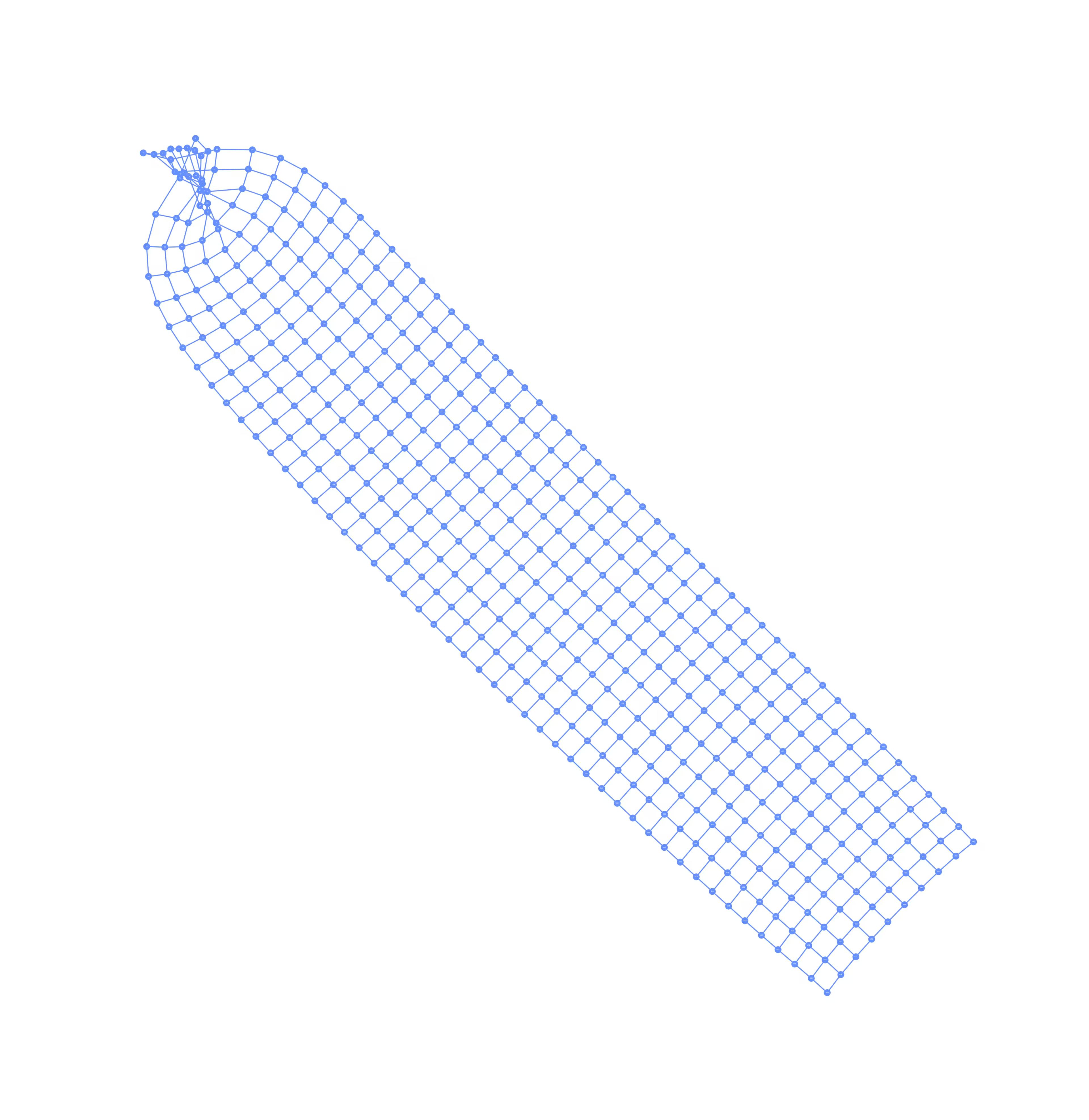
Misc. Features
-
Added support for expressing the sign of a
ParameterExpression. Instead of assigning a concrete value and usingnumpy.signor other library functions, the user can use the instance of theParameterExpressionclass to calculate the sign and can work with the sign before the expression is fully assigned.It can be used as follows:
from qiskit.circuit import Parameter

b = Parameter("phi")
sign_value = b.sign()
print("sign of an unassigned Parameter is: ", sign_value)
print("Sign of a Parameter assigned to -3 is: ", sign_value.assign(b,-3))
Refer to #10360 for more details.
-
Parameternow has an advanced-usage keyword argumentuuidin its constructor, which can be used to make theParametercompare equal to another of the same name. This should not typically be used by users, and is most useful for custom serialisation and deserialisation.
Circuits Upgrade Notes
-
The
ControlledGate.definitionof the output from theGate.control()method may be different as compared to previous releases. The internal generation of theGate.control()method is no longer using the now deprecatedUnrollertranspiler pass to generate its definition and this can potentially cause a different definition to be generated. The outputControlledGateobject’s definition will be unitary equivalent to what was generated before. But if you require the exact definition from callingGate.control()you can use an earlier release and save the circuit withqpy.dump()and then load it with a newer release. -
The property
num_ancilla_qubitsfrom the classPolynomialPauliRotationshas been removed, as deprecated in Qiskit 0.23.0. Instead, use the propertyPolynomialPauliRotations.num_ancillas. -
The following standard library gates:
are no longer able to set
label,condition,duration, orunit(andctrl_stateforControlledGatesubclasses) after instantiating an object anymore. You can still setconditionthrough the usec_if(). You can useto_mutable()to get a mutable copy of the instruction and then use the setter on that copy instead of the original object.label,durationandunitcan be given as keyword arguments to these gates at construction time, and a mutable instance will be returned automatically. This change was necessary as part of converting these classes to beSingletonGateandSingletonControlledGatetypes which greatly reduces the memory footprint of repeated instances of these gates. -
For anything that interacts with
Gate,Operation, orInstructionobjects or works with these as part of aQuantumCircuitorDAGCircuitclasses, it is important to note that the use of shared references for instances is much more common now. Previously, it was possible to reuse and share an instance of a circuit operation, but it wasn’t very commonly used and a copy would generate a unique instance. This has changed starting in this release because ofSingletonInstructionandSingletonGatebeing made available (and a large number of standard library gates now built off of them). If your usage of these objects is assuming unique instances for every circuit operation, this becomes a potential issue, as now a shared state will be reused between operations of the same type (that will persist through copy and deep copies). You can rely on theInstruction.mutableattribute to check the mutability of an object or useInstruction.to_mutable()to get a mutable copy of any instruction. -
More
Instructioninstances (those that return singletons) no longer strictly satisfy (for example):type(XGate()) is XGateThe returned object will, however, still be a standard subclass so
isinstance()(the correct way to do type checking) will continue to work correctly. Several instructions already had this property (e.g.MCXGate), but it is now more common as many more standard gates will do this.If you require the “base” type of a gate for some reason, omitting the synthetic singleton subclasses, which cannot be instantiated, see
Instruction.base_class. -
The definition of
UnitaryGatefor single qubit unitaries is now in terms ofUGateinstead of the legacyU3Gateclass.
Providers Upgrade Notes
-
The
QasmSimulatorPypython-based simulator included inqiskit.providers.basicaernow includes'h'(HGate),'p'(PhaseGate), and'u'(UGate) in its basis gate set. -
The argument
channelin the methodPulseBackendConfiguration.control()is removed. It was deprecated in Qiskit 0.33 (with Terra 0.19), released on Dec 2021. Instead use thequbitsargument. -
Replaced the argument
qobj[Qobj]inQasmSimulatorPy.run()withrun_input[QuantumCircuit or list]Here is an example to migrate your code:
# Importing necessary Qiskit libraries
from qiskit import transpile, QuantumCircuit
from qiskit.aer import QasmSimulator

# Defining the Quantum Circuit
qc = QuantumCircuit(2)
qc.h(0)
qc.cx(0, 1)
qc.measure_all()

# Transpile the circuit to optimize for the target simulator
simulator = QasmSimulator()
transpiled_circuit = transpile(qc, simulator)
# Run the simulation
job = simulator.run(transpiled_circuit, shots=1024)
# Get the simulation result
result = job.result()
All these were deprecated since 0.22 (released on October 13, 2022) and now they are removed.
Pulse Upgrade Notes
-
The functions
qiskit.scheduler.utils.format_meas_map(),qiskit.scheduler.utils.measure(), andqiskit.scheduler.utils.measure_all()had been moved toqiskit.pulse.utils.format_meas_map(),qiskit.pulse.macros.measure(), andqiskit.pulse.macros.measure_all()respectively. The previous location was deprecated in Qiskit 0.20.0 (Terra 0.15.0, released on 2020-08-10) and it is no longer supported. -
The methods
to_dictin the classespulse.transforms.AlignmentKind,pulse.transforms.AlignEquispaced, andpulse.transforms.AlignFuncare removed. They were deprecatedin Qiskit 0.37 (with Terra 0.21), released on June 2022.
QPY Upgrade Notes
- The use of the keyword
circuitsfor the first positional argument in the functionqiskit.qpy.dump()is removed as its usage was deprecated in Qiskit 0.37 (with Terra 0.21), released on June 2022. Instead, use the keywordprogramscan be used instead (or just pass the argument in positionally), which behaves identically.
Quantum Information Upgrade Notes
-
The method
qiskit.quantum_info.pauli_basis()does not accept thepauli_listargument any more. It was deprecated in Qiskit 0.39 (with Terra 0.22), released on Oct 2022. -
The function
random_stabilizer_tablein theqiskit.quantum_info.randommodule is removed. It was deprecated in Qiskit 0.39 (with Terra 0.22), released on Oct 2022. Instead, useqiskit.quantum_info.random.random_pauli_list(). -
The classes
qiskit.quantum_info.PauliTableandqiskit.quantum_info.StabilizerTableare removed. The functionrandom_pauli_table()is also removed. They were deprecated in Qiskit 0.43 (with Terra 0.24), released in May 2023. Instead, you should usePauliListandrandom_pauli_list(). -
The arguments
zandxto the initializer of toPauliwere removed, as deprecated in Qiskit Terra 0.17 (released on April, 2021). A pair ofxandzshould be passed positionally as a single tuple instead (Pauli((z, x))). -
The argument
labelto the initializer ofPauliwas removed, as deprecated in Qiskit Terra 0.17 (released on April, 2021). Pass the label positionally instead, such asPauli("XYZ"). -
Importing from
qiskit.quantum_info.operators.pauliis not allowed anymore, as it was deprecated in Qiskit Terra 0.21 (released on June, 2022). Import directly fromqiskit.quantum_infoinstead.
Synthesis Upgrade Notes
- The parameter
orderinsynthesis.SuzukiTrotterconstructor raises an exception instead of deprecation warning when set in an odd number. Suzuki product formulae are symmetric and therefore only defined for even orders.
Transpiler Upgrade Notes
-
As a consequence of the pass manager refactoring efforts, existing flow controllers:
FlowControllerLinear,ConditionalController, andDoWhileControllerare now subclasses of theBaseController. Note that these controllers have dropped the implementation of the__iter__()method. They are now only iterable in the context of a flow-controller execution, which threads the compilation state through after each inner task is executed. -
The functionalitly of the
RunningPassManagerclass has been superseded by the new pass manager framework (BasePassManagerandBaseController). The running pass manager is now a stateless flow controller (essentially, an alias ofFlowControllerLinear), as the pass manager is responsible for the construction of task pipeline, while the controller is responsible for the execution of associated tasks. Subclassing theRunningPassManageris no longer recommended, and this class will be completely replaced with the flow controller in future releases. -
A new class,
WorkflowStatus, has been introduced to track the status of the pass manager workflow. This portable object is created when the pass manager is run, and handed over to the underlying tasks. Such status was previously managed by theRunningPassManagerwith instance variables. -
The transpiler-specific
transpiler.PassManager(used intranspile()) is now a subclass ofpassmanager.BasePassManager. However, this class hierarchy change doesn’t introduce any breaking change to the public-facing API. -
Exceptions raised during pass-manager execution now inherit from the newly introduced
PassManagerError. A generic failure of the pass-manager machinery will raisePassManagerErrorfor general pass managers, but the transpiler-specifictranspile.PassManagerwill currently wrap this in its specificTranspilerErrorfor backwards compatibility. This wrapping will be removed in the future. -
The use of
FencedObjectin the pass manager framework has been removed. This wrapper class cannot protect mutable object attributes from modification, and this should not be an issue for properly implemented code. Analysis passes should not modify an input IR, controllers should not update the property set, and so forth. It’s the pass manager developer’s responsibility to ensure that the pass is not modifying object attributes, -
The plugin name
defaultis reserved for the plugin stagesinit,layout,optimization, andscheduling. These stages previously did not reserve this plugin name, but thedefaultname is now used to represent Qiskit’s built-in default method for these stages. If you were using these names for plugins on these stages these will conflict with Qiskit’s usage and you should rename your plugin. -
Disabled the use of the
RemoveResetInZeroStateclass in the preset passmanagers. Previously, whentranspile()orgenerate_preset_pass_manager()was run withoptimization_levelat level 1, 2, or 3, it would runRemoveResetInZeroState. However, this pass prohibited the notion of arbitrary initial states unless explicitly set to zeros with resets. If you need to run the pass as part of your compilation pipeline, you can run something like:pm = generate_preset_pass_manager(1, backend) pm.init.append(RemoveResetInZeroState()) pm.run(circuit)to retain this functionality for your circuit compilation.
-
The deprecated transpiler routing pass,
BIPMappinghas been removed. It was marked as deprecated in the Qiskit 0.43.0 release. It has been replaced by an external plugin package:qiskit-bip-mapper. Details for this new package can be found at the package’s github repository:The pass was made into a separate plugin package for two reasons: first, the dependency on CPLEX makes it harder to use, and secondly, the plugin package integrates more cleanly with
transpile(). The optional extrabip-mapperto installcplexanddocplexto support this pass has been removed as nothing in Qiskit optionally requires it anymore. -
The argument
qubitsin the methodInstructionDurations.get(), does not acceptQubit(or a list of them) any more. This functionality was deprecated in Qiskit 0.33 (with Terra 0.19), released on Dec 2021. Instead, use an integer for the qubit indices. -
Removed the argument
qubit_channel_mappinginRZXCalibrationBuilder, which was deprecated in Qiskit 0.39 (released on Oct 2022, with qiskit-terra 0.22) -
In
transpiler.CouplingMapmethodsubgraphis removed as deprecated in 0.20.reduce()can be used in place of methodsubgraph.
Visualization Upgrade Notes
-
Removed support for using the keyword
rhofor the first positional argument inplot_state_hinton(),plot_bloch_multivector(),plot_state_city(),plot_state_paulivec(), andplot_state_qsphere(). The use ofrhohas been replaced bystate, which can be used instead. Removedqiskit.scheduler.utilsas all contained functions were moved toqiskit.pulse.macrosandqiskit.pulse.utils. All these were deprecated since 0.15 (released on August 06, 2020) and now they are removed. -
The class constructor arguments
qregs,cregs,layoutandglobal_phaseforvisualization.QCircuitImageare removed, as they were deprecated in 0.20. -
The visualization functions:
plot_gate_map(),plot_coupling_map().plot_error_map(), andplot_circuit_layout()now depend on graphviz being installed to function. This change was necessary to enable visualizing backends with larger numbers of qubits. This additional external requirement is in addition to the existing optional dependencies these functions previously required. You find details on how to install graphviz here: https://graphviz.org/download/
Misc. Upgrade Notes
-
The
QuasiDistributionvalues might include floating-point errors.QuasiDistribution.__repr__rounds usingnumpy.round()and the parameterndigitscan be manipulated with the class attribute__ndigits__. The default is15. -
The class
qiskit.qobj.Qobjis removed. It was deprecated in Qiskit 0.33 (with Terra 0.19), released on Dec 2021. Instead, useqiskit.qobj.QasmQobjorqiskit.qobj.PulseQobj. -
The decorator
qiskit.utils.deprecation.deprecate_function()has been deprecated since Qiskit 0.39.0 (released on October 2022, with qiskit-terra 0.22.0) and now is been removed. Useqiskit.utils.deprecate_func()instead. -
The function
execute()does not accept the argumentsqobj_idandqobj_headerany more. Their use was deprecated in Qiskit 0.37 (with Terra 0.21), released on June 2022. -
The transpilation pass
qiskit.transpiler.passes.CXDirectionis removed. Its use was deprecated in Qiskit 0.37 (with Terra 0.21), released on June 2022. Instead, use the more genericGateDirectionpass. -
The transpilation pass
qiskit.transpiler.passes.CheckCXDirectionis removed. Its use was deprecated in Qiskit 0.37 (with Terra 0.21), released on June 2022. Instead, use the more genericCheckGateDirectionpass. -
Building Qiskit from source now requires a Rust compiler compatible with language version 1.64. This has been increased from the previous minimum supported Rust version of 1.61 for building earlier versions of Qiskit.
Algorithms Deprecations
- The algorithm utils in
qiskit.utils.validationandqiskit.utils.algorithm_globalsare now deprecated and will be removed in no less than 3 months from the release date. These utils were introduced with theqiskit.algorithmsmodule to support legacy and primitive-based algorithm workflows. Now thatqiskit.algorithmsis deprecated and the primitive-based algorithms codebase has been migrated to a standalone library, these utils are no longer used in the context of Qiskit. If your application allows it, we recommend that you migrate your code to use qiskit_algorithms, where you will be able to import the relevant utilities inalgorithm_globalsandvalidationfromqiskit_algorithms.utils. Please note that legacy functionality has not been migrated to the new package.
Circuits Deprecations
-
Passing
Noneas theqargsorcargsarguments toDAGCircuit.apply_operation_back()orapply_operation_front()is deprecated and will be removed in Qiskit 1.0. This has been explicitly against the typing documentation for some time, but silently accepted by Qiskit. Instead, simply pass()rather thanNone. -
The method
QuantumCircuit.bind_parameters()is now deprecated and will be removed from the codebase in no less than 3 months from the release date. Its functionality overlapped highly withQuantumCircuit.assign_parameters(), and can be totally replaced by it. Please useQuantumCircuit.assign_parameters()instead. -
Deprecate duplicate gate methods on
QuantumCircuit. The rule applied is that the method names reflect that gate names, e.g. theCXGateis added viaQuantumCircuit.cx()and notQuantumCircuit.cnot(). The deprecations are:QuantumCircuit.cnot()in favor ofQuantumCircuit.cx()QuantumCircuit.toffoli()in favor ofQuantumCircuit.ccx()QuantumCircuit.fredkin()in favor ofQuantumCircuit.cswap()QuantumCircuit.mct()in favor ofQuantumCircuit.mcx()QuantumCircuit.i()in favor ofQuantumCircuit.id()
Note that
QuantumCircuit.i()is the only exception to the rule above, but sinceQuantumCircuit.id()more intuively represents the identity and is used more, we chose it over its counterpart. -
To streamline the structure of Qiskit’s gates and operations, the
qiskit.extensionsmodule is pending deprecation and will be deprecated in a future release. The following objects have been moved toqiskit.circuit.libraryDiagonalGate,HamiltonianGate,Initialize,Isometry,MCGupDiag,UCGate,UCPauliRotGate,UCRXGate,UCRYGate,UCRZGate,UnitaryGate.
These instructions have already been deprecated in this release,
SingleQubitUnitary, instead uselibrary.UnitaryGate,Snapshot, which has been superseded by Qiskit Aer’s save instructions,
along with their circuit methods
In addition, the following circuit methods are pending deprecation
QuantumCircuit.diagonal(),QuantumCircuit.hamiltonian(),QuantumCircuit.isometry()andQuantumCircuit.iso(),QuantumCircuit.uc(),QuantumCircuit.ucrx(),QuantumCircuit.ucry(),QuantumCircuit.ucrz().
Since the entire module is pending deprecation, so is
ExtensionError. -
The little-used
QuantumCircuitclass data attributesheaderandextension_libare deprecated and scheduled for removal. These respectively held strings of the OpenQASM 2.0 version header statement andqelib1.incinclude statement. No alternative will be provided; these were mostly intended as internal details.
Transpiler Deprecations
-
The flow controller factory method
FlowController.controller_factory()is deprecated along withFlowController.add_flow_controller()andFlowController.remove_flow_controller(). In the future, task construction with keyword arguments in theBasePassManager.append()method will also be deprecated. Controllers must be explicitly instantiated and appended to the pass manager. For example, the previously used conventional syntaxpm.append([task1, task2], condition=lambda x: x["value1"] > 10)must be replaced with
controller = ConditionalController([task1, task2], condition=lambda x: x["value1"] > 10)
pm.append(controller)
The latter allows more precise control on the order of controllers especially when multiple keyword arguments are specified together, and allows for the construction of general flow controllers that may have more than one pipeline or do not take a single simple conditional function in their constructors.
-
The
FlowControllerLinear.append(),DoWhileController.append(), andConditionalController.append()methods are all deprecated immediately. The construction of the pass manager task pipeline is now the role ofBasePassManager, and individual flow controllers do not need to this method. For a flow controller, all the passes should be specificed in one go directly to the constructor. -
The general attribute and variable name
passesis replaced withtasksall over theqiskit.passmanagermodule. Note that a task must indicate a union of pass and controller, and the singular form pass conflicts with the Python keyword. In this sense, the use of tasks is much preferable. -
The
Unrollertranspiler pass has been deprecated and will be removed in a future release. TheUnrollerhas been superseded by theBasisTranslatorwhich provides a similar set of functionality but offers it in a more general manner so that you’re able to translate a circuit to any universal basis set. TheUnrollerclass only works in situations where the circuit’s gate definitions are recursively defined in terms of the target basis; for Qiskit’s standard library gates this meansUGateandCXGate. If you are using theUnrollerpass it can be replaced by using a custom pass manager of the form:from qiskit.transpiler import PassManager from qiskit.transpiler.passes import UnrollCustomDefinitions, BasisTranslator from qiskit.circuit.equivalence_library import SessionEquivalenceLibrary as sel pm = PassManager( [ UnrollCustomDefinitions(sel, basis_gates=basis_gates), BasisTranslator(sel, target_basis=basis_gates), ] ) pm.run(circuit) -
The use of the value
"unroller"for thetranslation_methodkeyword argument on thetranspile()andgenerate_preset_pass_manager()has been deprecated. This translation stage plugin will be removed from Qiskit in a future release as it has been superseded by the default"translator"method which will work similarly to the"unroller"plugin but support a broader set of target backends.
Visualization Deprecations
-
The default
matplotlibdrawer setting now issues aFutureWarning, as the default style is changing to the"iqp"style (previously known as"iqx"). The old default is available as the"clifford"style. To silence the warning, you can explicitly set the desired style, e.g.:from qiskit import QuantumCircuit circuit = QuantumCircuit(2) circuit.x(0) circuit.h(0) circuit.cp(0.5, 0, 1) circuit.draw("mpl", style="clifford") # or style="iqp" -
Passing a circuit to
qiskit.visualization.timeline_drawer()that does not have scheduled node start-time information is deprecated. Only circuits that have gone through one of the scheduling analysis passes (for exampleALAPScheduleAnalysisorASAPScheduleAnalysis) can be visualised. If you have used one of the old-style scheduling passes (for exampleALAPScheduleorASAPSchedule), you can propagate the scheduling information by running:from qiskit import transpile from qiskit.transpiler import InstructionDurations scheduled = transpile( my_old_style_circuit, optimization_level=0, scheduling_method="alap", instruction_durations=InstructionDurations(), )This behaviour was previously intended to be deprecated in Qiskit 0.37, but due to a bug in the warning, it was not displayed to users until now. The behaviour will be removed in Qiskit 1.0.
Bug Fixes
-
The maximum number of qubits to consider for matrix multiplication-based commutativity check in
CommutationCheckeris now limited to 3 by default. Fixed #10488 -
The
GateDirectiontranspiler pass will now use discrete-basis translations rather than relying on a continuousRYGate, which should help make some discrete-basis-set targets slightly more reliable. In general,transpile()only has partial support for basis sets that do not contain a continuously-parametrised operation, and so it may not always succeed in these situations, and will almost certainly not produce optimal results. -
Fixed
CommutationAnalysisto group gates on a wire into sets, with each set only containing gates that pairwise commute. This preventsCommutationCancellationfrom performing unsound optimizations. See #8020 -
CUGatewill now behave correctly during calls toQuantumCircuit.assign_parameters(). Previously, it would cause various odd errors, often some time after the initial circuit assignment. See #7326, #7410, #9627, #10002, and #10131. -
The control-flow builder interface (the context-manager forms of
QuantumCircuit.if_test(),while_loop(),for_loop()andswitch()) will now correctly track a separate global-phase advancement within that block. You can add a global-phase advancement to an inner block by assigning toQuantumCircuit.global_phasewithin a builder scope:from math import pi from qiskit import QuantumCircuit qc = QuantumCircuit(3, 3) qc.global_phase = pi / 2 # Set the outer circuit's global phase. with qc.if_test((qc.clbits[0], False)) as else_: # The global phase advancement in a control-flow block begins at 0, # because it represents how much the phase will be advanced by an # execution of the block. The defined phase of the outer scope is not # affected by this set. qc.global_phase = pi with else_: # Similarly, the `else` block may induce a different global-phase # advancement to the `if`, so it can also be set separately. qc.global_phase = 1.5 * pi # The phase advancement caused directly by the outer scope is independent # of the phase advancement conditionally caused by each control-flow path. assert qc.global_phase == pi / 2The meaning of
QuantumCircuit.global_phaseis taken to be the global-phase advancement that is inherent to a single execution of the block. It is still a global phase advancement, in that if the block is entered, the phase of all qubits in the entire program will be advanced. -
Fix the coloring of the
"iqx"and"iqx-dark"matplotlib color schemes, which previously drew theRZGate,RZZGate, (multi-)controlledPhaseGates andiSwapGatein the wrong color. -
The hash of a
Parameteris now equal to the hashes of anyParameterExpressionthat it compares equal to. Previously the hashes were different, which would cause spurious additional entries in hashmaps whenParameterandParameterExpressionvalues were mixed in the same map as it violated Python’s data model. -
Fixed a bug in QPY serialization (
qiskit.qpy) where controlled unitary gates in a circuit could result would fail to deserialize. Fixed #10802. -
Fixes the implementation of
random_statevector()so that it samples from the uniform distribution. -
The pass
NoiseAdaptiveLayoutnow takesCouplingMapas an optional argument. This is used by the plugin to control on inconsistency betweenconfiguration()andproperties(), like in the case ofFakeMelbourne. Fixed #7677. -
The methods
QuantumCircuit.copy()andcopy_empty_like()will now raise an error if thenameargument is incorrectly typed, instead of generating an invalid circuit. -
The
"decay"heuristic ofSabreSwapandSabreLayoutnow tracks the depth correctly on physical qubits rather than mistakenly tracking the “depth” of swaps on virtual qubits. -
Fixed an oversight in the
ECRGatethat prevented setting anECRGate.labelattribute at object construction time. All otherGateclasses and subclasses enable setting alabelkeyword argument in the constructor. -
Fixed an oversight in the
Gate(and standard-library subclasses) constructor where thedurationandunitattributes could not be set as keyword arguments during construction. The parent classInstructionsupported setting this butGatewas previously not exposing this interface correctly. -
Added support to allow
SparsePauliOpdefault initialization passing an empty iterable to the static methodsfrom_list()andfrom_sparse_list(). Fixed #10159. -
The use of the (deprecated)
Optimizerclass onAQCdid not have a non-deprecated alternative path, which should have been introduced in Qiskit 0.44. It now accepts a callable that implements theMinimizerprotocol, as explicitly stated in the deprecation warning. The callable can look like the following example:from scipy.optimize import minimize from qiskit.transpiler.synthesis.aqc.aqc import AQC optimizer = partial(minimize, args=(), method="L-BFGS-B", options={"maxiter": 200}) aqc = AQC(optimizer=optimizer) -
Fixed an issue with the
Barrierclass. When adding aBarrierinstance to aQuantumCircuitwith theQuantumCircuit.append()method previously there was no validation that the size of the barrier matched the qargs specified. -
The
BlockCollapsertranspiler pass will now correctly handle circuits that contain more than one condition on the same classical register. -
BlueprintCircuitsubclasses will now behave correctly when the semi-public methodQuantumCircuit._append()is used with the blueprint in an unbuilt state, i.e. the circuit will be built before attempting the append. -
Adjusted zoom, fontsize, and margins in
plot_state_city()to fit the plot better for more figure sizes. Corrected the Z-ordering behavior of bars and the zero-amplitude plane, and corrected display of negative real value bars.
Other Notes
-
This version of Qiskit is explicitly pinned to the Numpy 1.x series, because it includes compiled extensions that are not yet compiled against the as-yet-unreleased Numpy 2.x series. We will release a new version of Qiskit with Numpy 2.x support as soon as feasible.
We cannot prevent your package manager from resolving to older versions of Qiskit (which do not have the same pin but are still likely to be incompatible) if you forcibly try to install Qiskit alongside Numpy 2, before we have released a compatible version.
-
Modified the behavior of the
VF2LayoutandVF2PostLayouttranspiler passes, which would previously run their internal scoring using multithreading if the input circuits were sufficiently large. The multithreading usage has now been removed from the passes, as it was shown to cause a performance regression instead of an improvement like originally intended.